Concrete Contractors Calgary
Pads, Slabs and Flatwork Done Right
Blueprint pours concrete pads, garage slabs, driveways, walkways and patios across Calgary. Good concrete starts below the surface, with a compacted gravel base, straight forms and a mix made for our freeze and thaw winters. We locate utilities before we dig, prepare the base properly and finish the surface so water runs off it. You deal with the owner, from the estimate to the final cleanup.
Request a Concrete Estimate
Tell us what you want poured and we will call you back.
Calgary Homeowners Rate Us 5 Stars on Google
Posted on Google![]()
Mark LacernaTrustindex verifies that the original source of the review is Google.
I’m very happy with the siding work done on my home! The contractor was professional, reliable, and paid great attention to detail. The quality of the workmanship was excellent, and everything turned out looking great. Communication was good throughout the process, and the job was completed with care. I would definitely recommend them to anyone looking for quality siding work. Thanks for a job well done!Posted on Google![]()
Reeta BashyalTrustindex verifies that the original source of the review is Google.
Baljeet and his team did vinyl siding installation in our home. The team is very hard working, detail oriented and gave a great service. Also the work area is very clean with no mess around very well organized. I would definitely recommend them.Posted on Google![]()
Fabiola STrustindex verifies that the original source of the review is Google.
Great service from the owner. I would recommend this company.Posted on Google![]()
Kelly MathisonTrustindex verifies that the original source of the review is Google.
We had new gutters and downspouts installed. While they were here, they also did some repair work on existing gutters & soffits . Baljeet & his crew were fast and efficient. They communicated well in advance & throughout the project. They arrived on time, quote was accurate. We were very pleased with their work. Would definitely have them back & would recommend them.Posted on Google![]()
Cam PepperdineTrustindex verifies that the original source of the review is Google.
There are so many good things to say about Blueprint Construction and it is impossible to fit everything I want to say within a single Google review. Our house was heavily damaged by a hail storm, and Blueprint Construction was incredibly helpful right from the start. The owner came to our home the same day we reached out and he provided a detailed quote. I also received quotes from a few different companies and Blueprint saved me about $9000 in total for siding and roof replacement/repair. There was very little waiting, and the team that worked on our house was incredibly professional. They went above and beyond and you could tell that they cared about their work. The clean-up was also well-done, and I couldn't find any nails or other stray materials on my lawn or flowerbed. The end result was fantastic and the owner checked-in with us throughout the process to ensure we were satisfied with everything. Overall, I couldn't be happier and I would highly recommend this company for anyone needing repairs to their house.Posted on Google![]()
Christoper CollinTrustindex verifies that the original source of the review is Google.
This company is great. Staff knowledgeable and hard working. Went the extra mile to clean up and look like they were never there Highly recommended!!Load more
Concrete Work We Do in Calgary
Most of our concrete work is residential flatwork: the slabs and pads around a house that have to stay flat and solid for decades. That includes concrete pads for sheds, hot tubs and parking, garage slabs, driveways and walkways, patios and steps, and the repair or replacement of slabs that have cracked, settled or flaked. We also cut and remove concrete when a basement entrance or egress window needs an opening. Every job starts with an estimate on site, because the ground decides how the slab is built. If you are planning a building, see our garage builders page.
- Pads for sheds, hot tubs and parking
- Garage slabs and aprons
- Driveways and walkways
- Patios and steps
- Slab repair and replacement
- Concrete cutting for basement entrances
The Part You Never See
Base Preparation and Forms
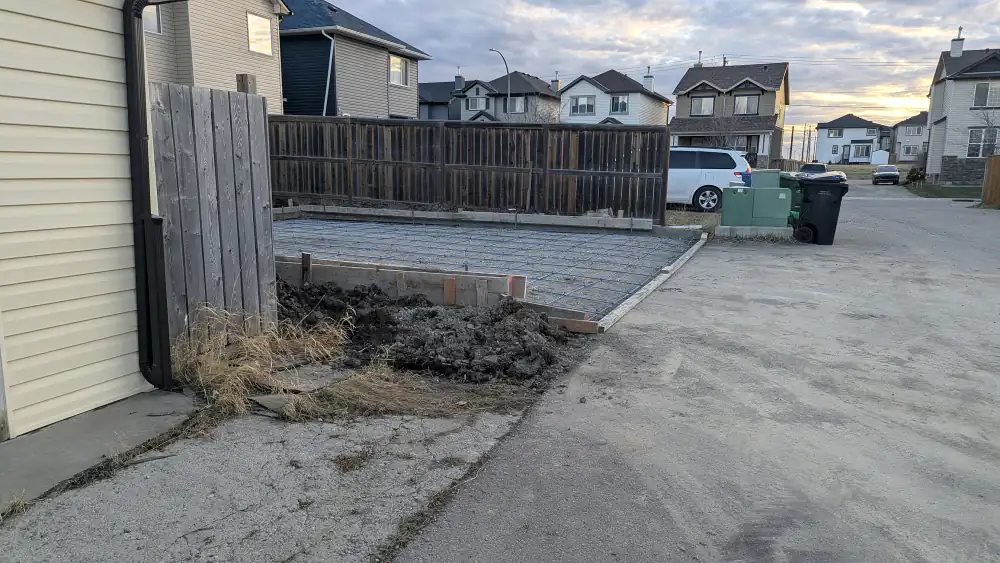
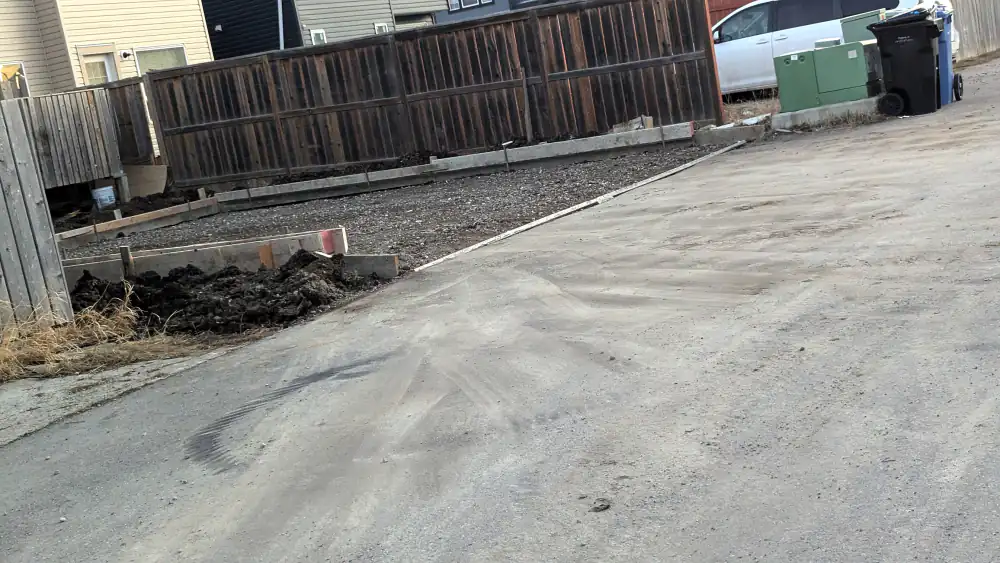
A slab is only as good as the ground under it. We strip the topsoil, bring in clean gravel and compact it in layers so the base cannot settle, then set straight forms to the slope the water needs. In Calgary, frost heave and our clay soils move concrete that sits on a poor base, which is how cracks and uneven panels start. The photo shows a compacted gravel base with forms set for a concrete pad on a Calgary lane.
- Topsoil removed and base compacted
- Clean gravel in layers
- Forms set straight and to slope
- Drainage planned before the pour
Mix, Pour and Finish
Concrete Pads and Slabs That Last
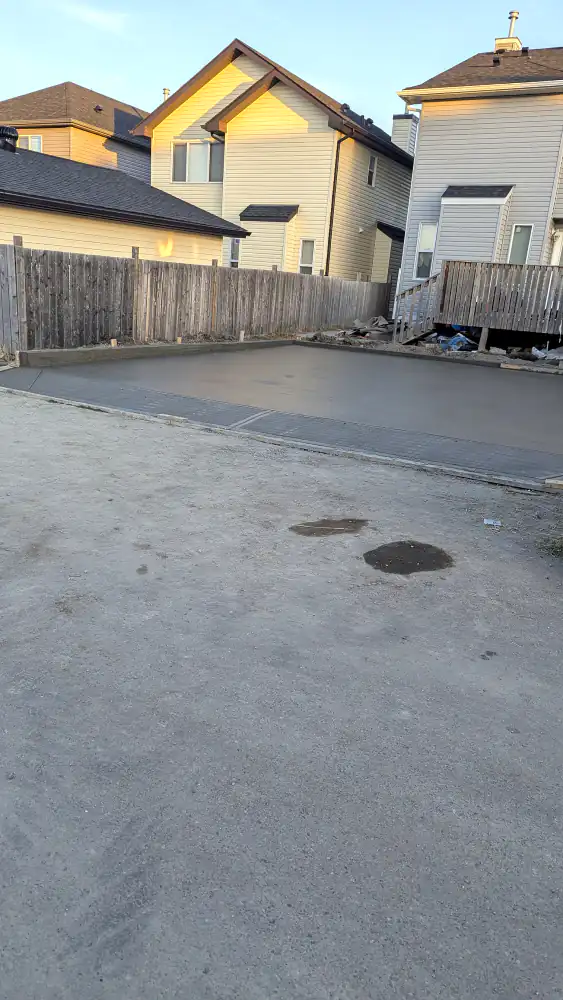
Exterior concrete in Calgary has to survive freezing, thawing and de-icing salt. That means a mix made for it: commonly an air-entrained mix around 32 MPa, which has tiny air bubbles that give frozen water room to expand. We place and level the concrete, finish the surface and cut control joints so any cracking happens along a straight line instead of across the slab. The photo shows a newly poured and finished pad with control joints behind a Calgary house.
- Air-entrained exterior mix
- Placed, levelled and finished
- Control joints cut
- Curing and sealing advice
Edges, Slopes and Transitions
Walkways, Aprons and Slab Edges
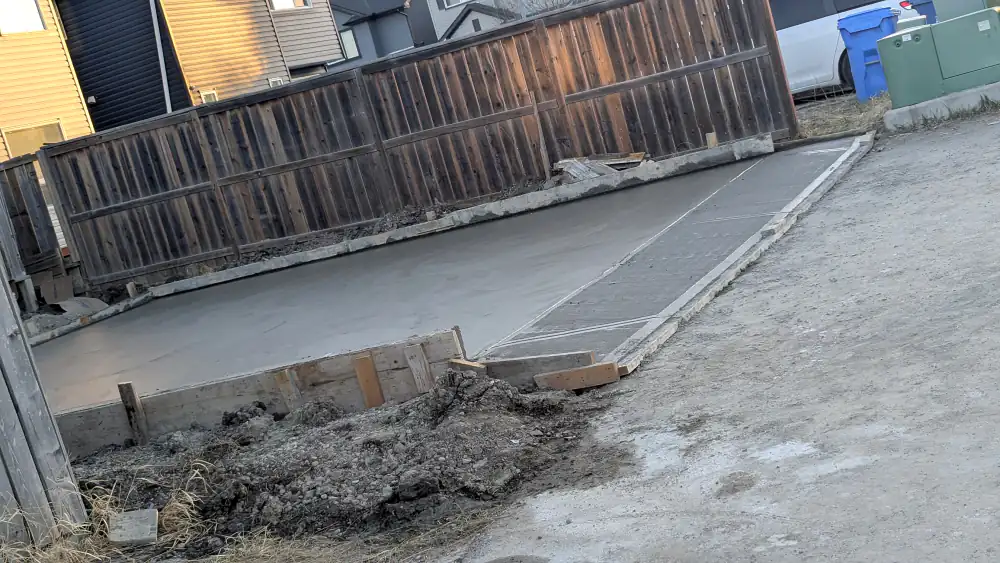
The edges are where concrete fails first, so we form them cleanly and slope every surface away from the house. A slab that drains toward the foundation or holds puddles will crack and flake. Where a pad meets a lane or a walkway, the transition is formed and finished so it does not trap water or trip anyone. The photo shows the formed edge of a new pad and its sloped transition to a Calgary lane.
- Edges formed and finished cleanly
- Surfaces sloped away from the house
- Smooth transitions to lanes and walks
- Steps and aprons formed to suit
Safe Ground Work
Click Before You Dig
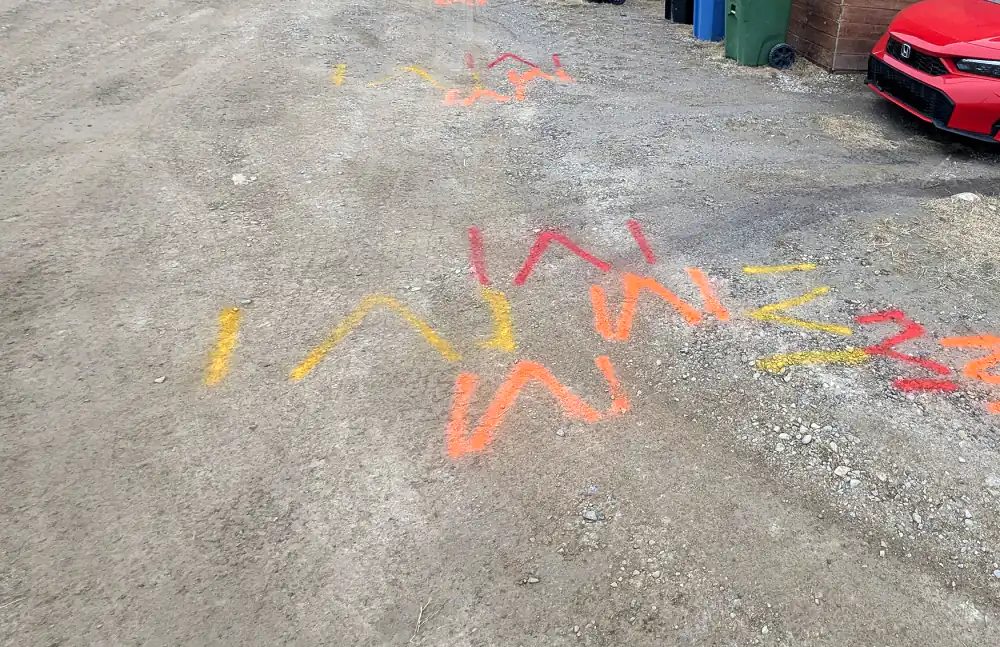
Excavating for a pad or footing disturbs the ground, and Calgary properties have buried gas, power and communications lines. Before we dig, we request free utility locates through Click Before You Dig, the Alberta One-Call service at 1-800-242-3447, and wait for the lines to be marked. Plan on at least three full working days. We work around the marks and dig carefully by hand near them where needed. The photo shows locate marks on the lane at our own concrete and fence job. The same steps apply to our fence and garage jobs.
- Locates requested before digging
- Marked lines respected
- Careful digging near marks
- Safer for you and your neighbours
Cracks are normal. Settling, scaling and heaving are not.
Concrete Repair or Replacement: Which Do You Need?
Repair makes sense when:
Cracks are narrow and not moving
The surface is sound and not flaking
The slab is level and drains properly
Damage is limited to one section
Replacement makes more sense when:
The slab has settled, heaved or tilted
The surface is scaling or crumbling widely
Water drains toward the house
Cracks keep reopening after repairs
Planning a Pour? Tell Us About It
Send the size, what it is for and a photo of the area, and we will call you back.
What Affects the Cost of Concrete Work
Size and Thickness
Concrete is sold by volume, so a larger or thicker slab costs more. A parking pad needs more thickness than a walkway.
Base and Excavation
Removing old concrete, topsoil or poor fill and bringing in gravel adds work before any concrete arrives.
Access and Pumping
If a truck cannot reach the site, the concrete has to be wheelbarrowed or pumped, which adds labour or equipment.
Finish and Extras
Broom finish is standard. Stamped or coloured concrete, reinforcement, steps and sealing change the price.
Common Concrete Problems in Calgary
Scaling and Flaking
The top layer peels off when water in the surface freezes and thaws, usually because the mix was not air-entrained, the surface was over-finished or de-icing salt was used too soon.
Settling and Heaving
A slab that sinks or lifts sat on a poor base, or on soil that holds water and moves in frost. The fix starts with the base, not the surface.
Wide or Uneven Cracks
Hairline cracks along control joints are normal. Wide cracks, or panels sitting at different heights, point to a base or thickness problem.
Water Pooling
A slab that drains toward the house or holds puddles stains, ices up in winter and wears faster. Slope is set when the forms are built, so it has to be right the first time.
Concrete Seasons in Calgary
Spring
Frost leaves the ground slowly and wet soil delays excavation. Book early, because the best weeks fill up fast once the ground is workable.
Summer
The easiest season for flatwork. Heat and wind dry the surface quickly, so we plan pours for cooler parts of the day and protect fresh concrete from drying too fast.
Fall
Good pouring weather continues until nights turn cold. We watch the forecast closely, because concrete must be protected once freezing temperatures arrive.
Winter
Pours in freezing weather need heated or insulated protection and are not suited to every job. For most homes, flatwork is better planned for the warm months.
Caring for New Concrete
Keep It Moist at First
Concrete gains strength as it cures, and curing needs moisture. In hot or windy weather, we advise keeping the surface damp for the first days.
Wait Before Heavy Loads
Light foot traffic is fine after a day or two. Keep vehicles off for about a week, and wait about 28 days before heavy loads.
Avoid De-Icing Salt
Do not use salt on new concrete during its first winter. Use sand for traction and shovel snow early.
Seal It
A sealer applied once the concrete has cured helps keep water and salt out of the surface. Ask us about timing and product.
Questions About Your Concrete Job?
Send the size, what it is for and a photo of the area, and we will call you back.
Book a Concrete Estimate
Frequently Asked Questions About Concrete
-
Q. How much does concrete cost in Calgary?
Concrete work is priced by area and thickness, plus excavation, base, access and finish. A small pad costs far less than a driveway, and removing old concrete adds to the job. We measure the site and quote the full job rather than guessing over the phone.
-
Q. How thick should a concrete pad or slab be?
A walkway or patio is commonly four inches thick, while pads that carry vehicles or heavy loads are thicker and often reinforced. We recommend the thickness for what the slab will carry.
-
Q. What kind of concrete is used for Calgary driveways and pads?
Exterior concrete here is commonly an air-entrained mix around 32 MPa, made to resist freezing, thawing and de-icing salts. The mix matters as much as the thickness.
-
Q. When can concrete be poured in Calgary?
Most flatwork is poured from spring through fall. Concrete can be poured in cold weather with the right precautions, but frozen ground and low temperatures make it harder, so we plan around the forecast.
-
Q. How long before I can drive on new concrete?
Walk on it after a day or two, and keep vehicles off for about a week. Concrete keeps gaining strength for weeks, and many contractors suggest waiting about 28 days before heavy loads and before using de-icing salt.
-
Q. Why does concrete crack, and can it be prevented?
All concrete shrinks as it cures, so some cracking is normal. Control joints are cut so cracks form along straight lines. A compacted base and proper thickness prevent the wide, uneven cracks caused by settling.
-
Q. Do you request utility locates before digging?
Yes. Every job that disturbs the ground starts with a locate request through Click Before You Dig. Plan on at least three full working days before we dig.
-
Q. Do I need a permit for a concrete pad or driveway?
A simple pad in a rear yard does not usually need a permit, but a driveway, a garage slab or anything near the property line or a City right-of-way can. Ask us when you call, and check the City of Calgary requirements for your property. We can talk through the rules as part of the estimate.
-
Q. Can you remove my old concrete first?
Yes. We break out and haul away old slabs, driveways and walkways, then prepare the base and pour the new concrete. Removal is part of the estimate, because the weight, thickness and access change the work and the price.
-
Q. What does a concrete quote include?
A clear quote lists the size and thickness, excavation and removal, gravel base, forms, any reinforcement, the concrete and finish, control joints and cleanup. If something is not included, it should say so, so you can compare quotes fairly.
-
Q. What is the difference between a pad and a slab?
The words are often used for the same thing. A pad is usually a smaller, flat area such as one for a shed or hot tub, while a slab is the larger floor of a garage or building. Both need a compacted base, the right thickness and a slope for drainage.
-
Q. Can you cut concrete for a basement entrance or egress window?
Yes. We cut and remove concrete for basement entrances and egress openings, and it fits with the rest of a basement development. Ask about it when you call. See our basement development page.
